
THOUGHT EXPERIMENTS IN PUBS
ST PANCRAS
CLASS
By Ben Lovejoy

1 MASTERCLASS
Jay is an 18-year-old from a small town in the US visiting London for the first time. He’s really interested in the cultural differences between the UK and the US, and has done a lot of online research. Now he wants to meet interesting Londoners, so looks on Meetup and finds a group called Thought Experiments in Pubs. He decides to go along.
During the informal social time after the thought experiments, he asks a question. "Help me out here, guys," he says. "I'm trying to get a handle on how the concept of class differs between the US and the UK, and I’m really struggling to understand the British system.”
He continues: “It seems like how much money you make isn’t even a factor? I mean, you can have a tube driver on £70k a year and you call her working class. A new teacher earns less than half that, but you call him middle class. A barrister can earn as little as £23k in her first year, but Brits tell me she's at least upper middle class. You can also have a retired guy with no inherited wealth, a small pension and pennies in his bank account, but because of ... I don't know, his double-barrelled name or accent or family history or the fact that he wears a cravat or whatever, you guys call him upper class. How does it all work?”
You're now going to imagine Jay is sitting at your table and you have to collectively give him a masterclass on the British class system. Please don't hold back if you're not British: outside impressions can often deliver the greatest insights.
I suggest you begin the conversation organically, just responding to his initial question – but if you want some prompts, below are some additional questions he might ask along the way.
Additional questions Jay might ask:
What defines: working class, lower middle class, middle class, upper middle class and upper class?
Is class fixed at birth, or can you move between them at different points in your life?
If I moved to London, as an American, what would define my class?
What is your class, and why?
Would you care if other people perceived you to be from a lower class? A higher one?
Bonus question:
A TEiP friend said I should wear a bow tie for this thought experiment. To a stranger on the street, do you think that would impact their perception of my class compared to exactly the same clothing without it?
By: Ben Lovejoy, THOUGHT EXPERIMENTS IN PUBS Group Member - read more of his writing here.
2 CLASS DISMISSED
As the conversation continues, one of those present, Jack, wonders why Jay is so interested in class.
“It's not like it means anything these days. Almost everyone works, so you can argue we're all working class. Similarly, London scaffolders drink five quid lattes and go to bars that would be considered posh back where I come from in Hull, so you could argue we're all middle class. The upper class is so small it’s irrelevant. Sure, financial inequality matters, but like you say, there's no connection between class and money, so really, who cares?”
Amara disagrees.
“I can give you a very practical illustration of just how much class still matters. I was getting interviews for more senior roles but hadn't been offered any of them. My recruitment consultant said that, although it shouldn't really matter, and she was hesitant to raise it, the reality was that my working-class Essex accent probably counted against me. She recommended a voice coach who helped me develop a more middle-class accent, and I don't think it's coincidence that once I sounded more like a BBC newsreader I quickly got a far more senior position.”
Ben says he can give a trivial example, but one that does illustrate the point.
“Back before the London Eye fireworks on New Year's Eve, anyone who wanted to have the full-on London experience used to gather in Trafalgar Square. Four of us decided that everyone should do this once, and if we were going to do this very silly thing, we should do it in a very silly way. So we dressed up in tuxedos and evening gowns and took a Harrods hamper with us. It was only when we got to the police checkpoints on the approach that we realised alcohol was banned, as were glass containers. They were turning away people with crates of beer and bottles of spirits. We decided there was nothing to lose so gave it a go. A cop opened up the hamper, looked at the bottle of champagne, looked at us and said, ‘Yeah, okay,’ and let us through. That was pure middle-class privilege.” (True story, by the way.)
Hannah isn’t so sure.
“I mean, I can picture your experience, Ben, but I don’t think that was class prejudice – he was just making a perfectly reasonable assessment that your group was hardly likely to get riotously drunk or start throwing bottles around. I also get your point, Amara, but I think you were just unlucky in finding a few snobs. I'm not saying that classism doesn't exist, but I do think it's pretty trivial compared to sexism and racism.”
The group turns to you and asks what you think.
QUESTIONS TO CONSIDER:
How would you answer?
Have you had any personal experience of classism, either positively or negatively?
When might class be a greater advantage than wealth?
Do you think your class impacts your everyday life? If so, how?
If you think not, might anyone challenge you on that? What would they say?
If we could somehow eliminate class distinctions, what would be gained?
Would anything be lost?
What do you think of Hannah's view that classism is trivial compared to sexism and racism?
By: Ben Lovejoy, THOUGHT EXPERIMENTS IN PUBS Group Member - read more of his writing here.
3 CLASS-IFICATION
In the next room are three born-and-bred Londoners, identified only by the numbers 1, 2 and 3. One of them is working class, one middle class, and the other upper class. Your task is to identify the class of each person.
To do this, you are only permitted to ask each of them the same three questions. You'll never see them or hear their voices: an assistant will take your questions into the next room and return with their answers. Note that the assistant will only return with the factual information you requested – they won't be relaying word-for-word answers, so you won't have any clues from vocabulary, grammar or specific word choices (eg. lounge/living room/drawing room).
None of your questions can be on the nose. For example, you can't ask about their name, education, job, income, postcode, hobbies, reading habits, holiday destinations, concert attendance, where they do their shopping or how many bow ties they own. You can only ask questions which would give you indirect clues.
Your questions will be vetted, and rejected if they're too direct. Additionally, those being questioned are tasked with guessing the purpose of your questions. If any of them succeed, then you fail – so forget your cunning plan to ask them whether they think class matters! Your challenge is to be creative.
You task is to achieve consensus agreement on your three questions. (Please write these down as I would love to read them afterwards!)
Additional questions to consider along the way:
What potential questions would be rejected as too direct?
Which ones might pass vetting but still allow those in the next room to guess your aim?
If they did guess the purpose, might any of them be insulted by your apparent assumptions?
If you’re struggling to come up with suitable questions, why is that?
How reliable do you think this process might be?
Which class would be the easiest to identify? Why?
Which would be the hardest? Why?
By: Ben Lovejoy, THOUGHT EXPERIMENTS IN PUBS Group Member - read more of his writing here.
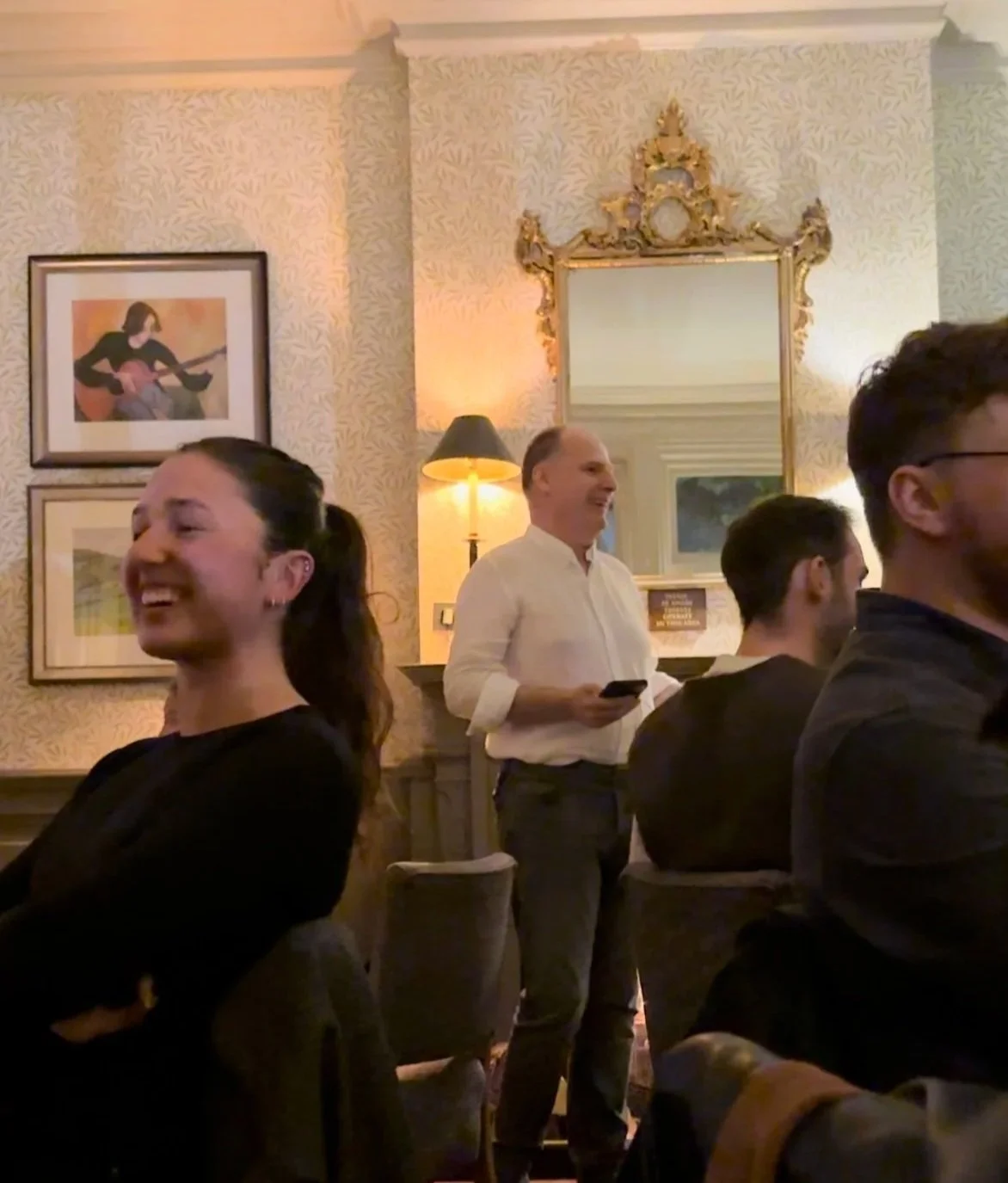
THE AUTHOR OF TONIGHT’S THOUGHT EXPERIMENTS
Ben is a freelance writer who creates occasional videos and dances rather a lot of Argentine tango. He may, on rare occasion, talk about the latter. As an insatiably curious person who considers it a hobby to quiz strangers about what they think and why, he’s found that this tends to be better received in pubs during TEiP events so can be found at most of them (though he does draw the line at west London). Noting that almost all TEiP conversations seem to include AI, he once attempted to give us all a chance to get this out of our system by writing a set of thought experiments specifically on AI. Yeah, that didn’t work (though was a lot of fun). He looks forward to eavesdropping on your thoughts about class.
@thoughtexperimentsinpubs
UPCOMING EVENTS
COACHING WITH BONNY
Space to explore something that matters to you:
an idea
a decision
a feeling
a pattern
a question that keeps coming back
We’ll work together to find clarity and next steps.
While in training I’m offering free and low cost sessions (the first three sessions are free, after that sessions are £15).
You can book directly into my calendar here:
If you have any questions, please feel free to get in touch :-)