THOUGHT EXPERIMENTS IN PUBS
BERLIN
EDUCATION

1 BACK TO SQUARE ONE
After a major review, the government has decided that what children learn in school doesn’t prepare them for life.
They have appointed a small committee to identify new, more relevant subjects to teach children in schools.
This committee has been chosen by the same methods as a jury: 12 names randomly selected from the electoral register.
You are chosen as one of the 12 educational jurors.
You and your fellows are each asked to nominate 3 core subjects for the new syllabus. You will present these to one another and make the case for them.
Out of the pool of nominated subjects, 6 will be chosen by consensus for the new national syllabus.
QUESTIONS TO CONSIDER:
What would your 3 subjects be?
How would you make the case for them?
What would you definitely remove from existing school subjects?
What would be the advantages of this process to make education more relevant?
What might be some of the drawbacks?
In what other ways might you be able to make education more relevant?
SOURCE: BA, THOUGHT EXPERIMENTS IN PUBS Group Member
2 CLIMB THE TREE
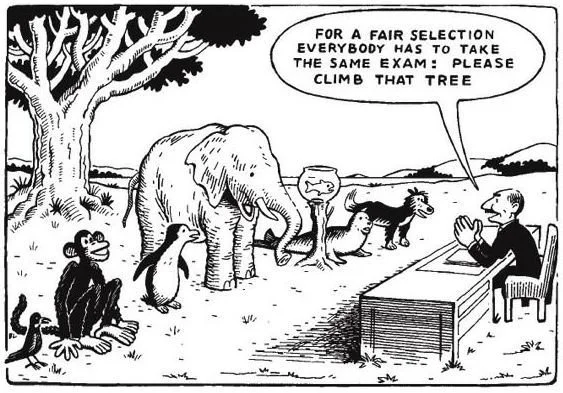
QUESTIONS TO CONSIDER:
How does this cartoon relate to the education system?
Do you find it a helpful provocation? Or is it irrelevant? Why?
How can we measure ability?
What is a ‘fair’ assessment/exam?
How would you evaluate learning?
How would you evaluate skill?
SOURCES:
CARTOON: via https://marquetteeducator.wordpress.com/2012/07/12/climbthattree/
QUESTIONS: BA, THOUGHT EXPERIMENTS IN PUBS Group Member
3 BABY ANIMALS
Guide Dog Puppies go to school to be trained as Guide Dogs. During this time they are required to pay attention, respond to trainers, and behave. They have regular breaks to walk and play.
In the evenings, volunteer caregivers collect the puppies, take them home, and care for them in the way mandated by the programme.
This training works well, but seeking to keep up with advances in training techniques and technologies, the directors decide to make a few changes.
A new screen based training programme has recently been developed for Guide Dog Puppies. It requires less staff and is more efficient. The directors of the school decide to switch to this model. They also purchase auxiliary training devices to give to the volunteer caregivers so that training can continue in the evenings.
The directors decide to maximise the puppies’ exposure to the new programme, running it for the duration of the school day, from 8AM-3PM. They cut down on play and walk breaks. They instruct the volunteer caregivers to play the programme for a further 3-4 hours in the evening on multiple devices.
Some puppies are ok with this new programme, but most begin to exhibit new behaviours. Some become despondent and listless. Many become hyperactive and distractible and begin acting out, even biting.
The directors call a meeting. They hear from two experts:
Expert A:
“Many of the puppies are now suffering from Rebellious Rambunctious Disorder (RRD), a previously undiagnosed condition that causes them to have limited attention and trouble focussing.
This disorder is common and natural. Many puppies have suffered from undiagnosed RRD in the past, but we are now in a position to treat it.
We suggest a prescription of amphetamines to help the puppies to concentrate. This will enable them to behave better during the programme and at home.”
Expert B:
“Puppies are baby animals and all baby animals need play and exercise in order to develop properly and to be healthy social creatures.
Exercise releases endorphins (happy hormones) and reduces cortisol (stress hormones). Play enables puppies to develop their social skills. We advise giving the puppies regular breaks during the programme, to go outside and play.
We also suggest reducing the amount of time the puppies are exposed to the programme at home, and simplifying their environment (i.e. removing the additional screens). This will make it easier for the puppies to concentrate during training.”
QUESTIONS TO CONSIDER:
As the director of the school, which expert would you listen to and why?
What do you think about the diagnosis: ‘Rebellious Rambunctious Disorder’? Is it helpful? Is it valid? Is it real?
How could you tell if there was a new disorder? How would you explain its emergence?
Does thinking about how we might treat baby animals affect how we think about treating and educating human children? How is it/isn’t it relevant?
SOURCE: BA, THOUGHT EXPERIMENTS IN PUBS Group Member, inspired by Attention Deficit Hyperactivity Disorder in Children: One Consequence of the Rise of Technologies and the Demise of Play,” in Sharna Olfman (ed.) All Work and No Play…How Educational Reforms Are Harming Our Preschoolers. Westport Ct.: Praeger, 2003, pp. 161-16.

Our newsletter (and more) can be found here:
Lets be friends on Instagram: @thoughtexperimentsinpubs
FEEDBACK
(Messages are anonymous unless you include your name/contact details)

If you’d like to support me to write more thought experiments and arrange more meetups, please…
Thank you, your support means a lot :-)