THOUGHT EXPERIMENTS IN PUBS
ST PANCRAS
MOOD

1 INSIDE (or) OUT
You are looking after your friend’s children for the afternoon.
Your friend suggested a cinema trip. He said that his kids love Pixar and there’s a new film out.
You google the film and find it.
INSIDE OUT is billed as:
“The new major emotion picture”.
The trailer depicts a family of three eating dinner. Mother, Father, and young daughter.
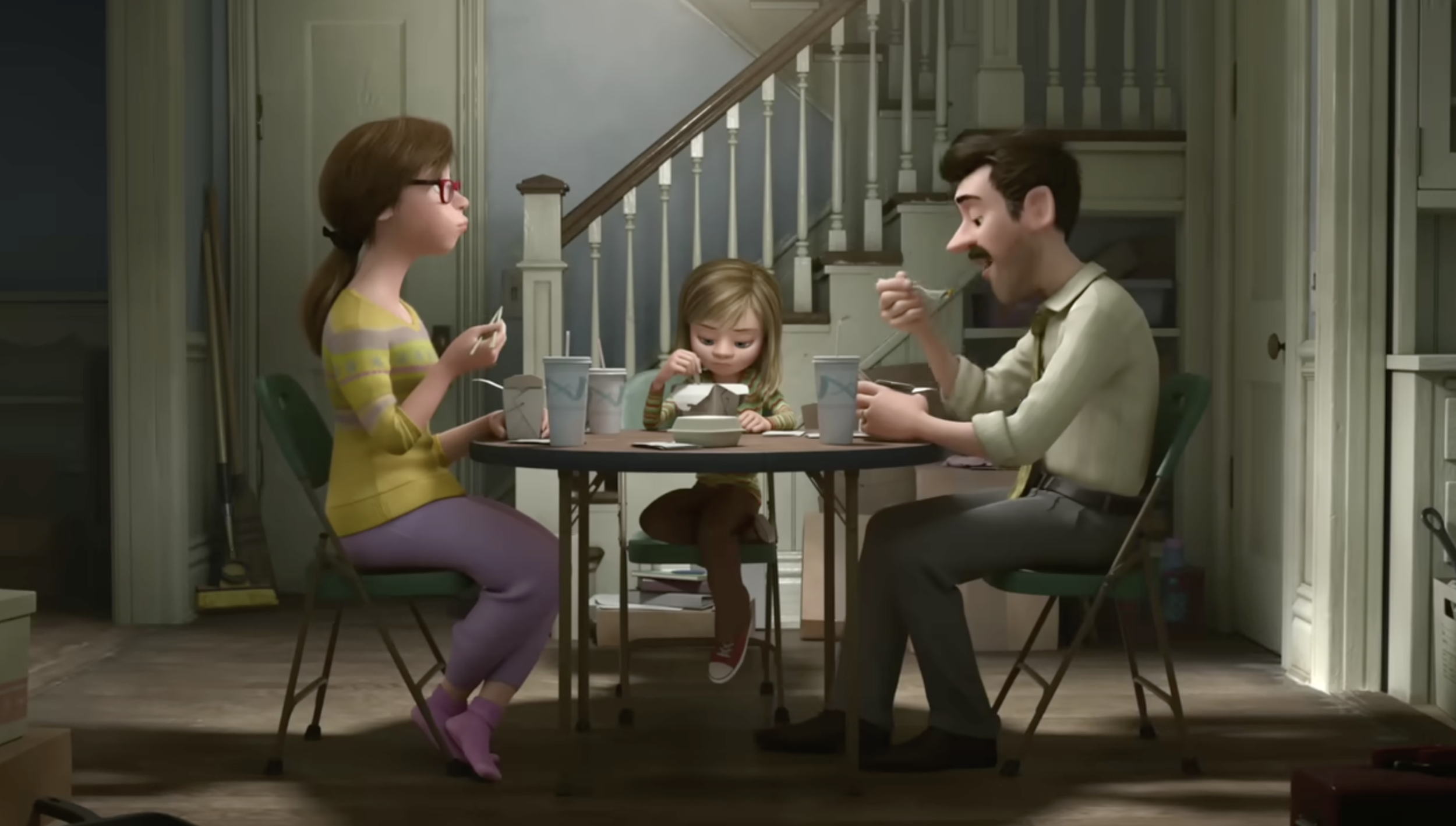
The mother asks her daughter, Riley, how her day at school was.
Riley responds in an irritated tone:
“It was fine I guess, I don’t know”.
A voiceover says:
“Do you ever look at someone and wonder ‘what is going on inside their head?”
Suddenly, the picture zooms into the mother’s head and we see five versions of the mother sitting at a control panel:
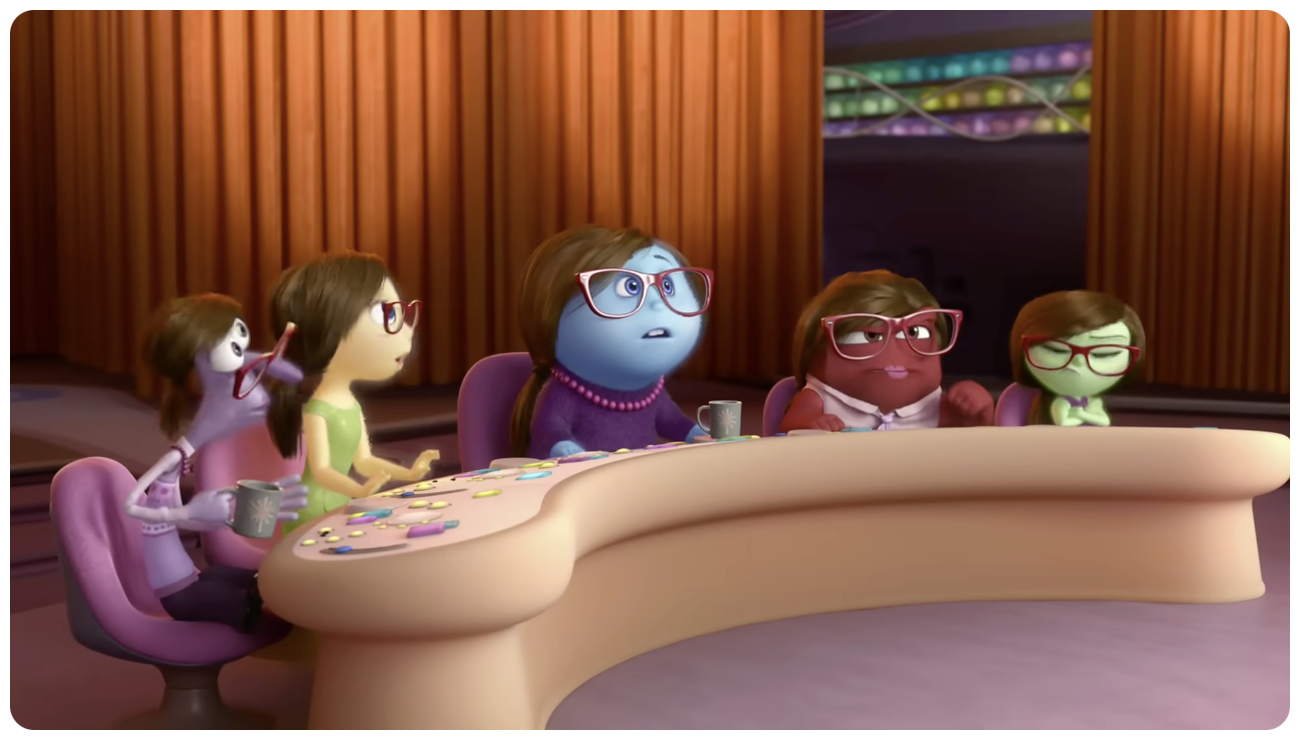
The five inner mothers are all different colours. They discuss how to respond to the daughter.
We soon learn that each of INSIDE OUT’s characters have five internal versions. The internal versions’ colours correspond to different emotions:
Yellow - Joy
Blue - Sadness
Red - Anger
Purple - Fear
Green - Disgust
During the film, you see how the inner versions of each character argue over how their respective character should respond to the world.
You follow Riley’s story, seeing both her outer self, and the five emotional Rileys within.
Leaving the cinema, with your friend’s children in tow, you think about this model for human emotional life.
One of the children asks you:
“So do moods come from inside then?”
QUESTIONS TO CONSIDER:
Do moods come from inside or outside?
Why do you think the film’s producers chose the title “INSIDE OUT”?
How does the model sit with you? So you feel subject to competing emotions? Are any of your emotions dominant?
Are the emotions represented in INSIDE OUT (i.e. Joy, Sadness, Anger, Fear, Disgust) comprehensive? Or should other emotions be represented?
Are moods the same as emotions? If not, what is a ‘mood’?
SOURCES:
BA, THOUGHT EXPERIMENTS IN PUBS Group Member - read more of her writing here.
Pixar. (2014, December 11). Inside Out – Official US trailer [Video]. YouTube. https://www.youtube.com/watch?v=yRUAzGQ3nSY
2 MEAN REDS & MOODY BLUES
You are in the back of a London cab with three of your friends.
You’re on the way to a wedding on the other side of London and you’re running late. The taxi is going to be very expensive, but it was your only option. You’ve got at least a half hour journey ahead.
Iva asks Dylan how dating is going.
Dylan:
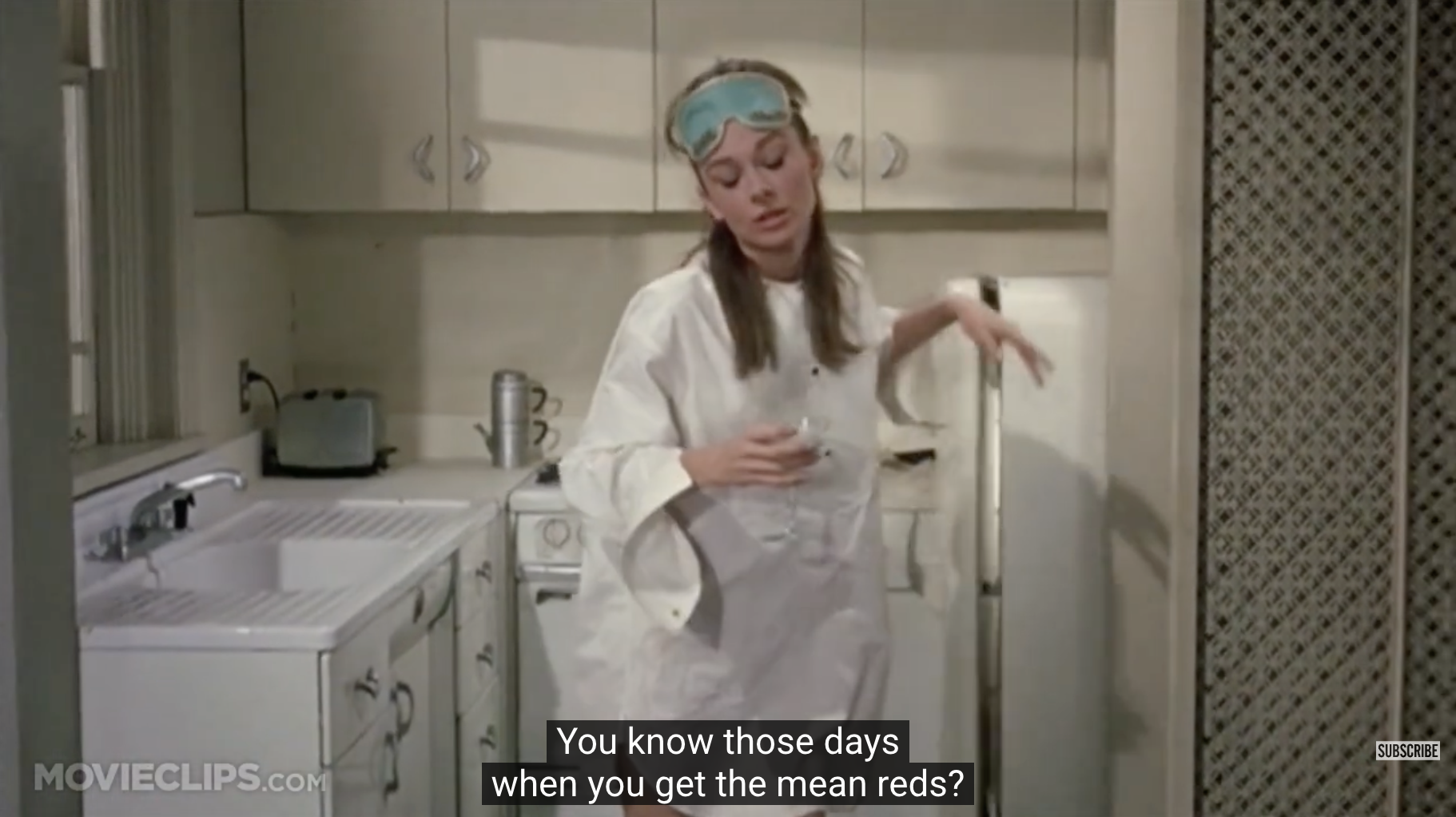
“Well I’ve been seeing someone quite a lot recently. She’s called Ellena and she’s amazing. She’s an artist, and she has that typically intense artists’ temperament. She’s full of life and charming and the centre of every room most of the time. Occasionally she gets really low and angry, which is also kind of intriguing in a way. She reminds me of Audrey Hepburn’s Character in Breakfast at Tiffany’s, Holly Golightly.”
Anna:
“No offence, Dylan, but I hate that character. She’s such a bad influence. She’s characteristic of a whole hollywood stereotype: women celebrated for their instability. The glamourisation of mental illness is toxic. Why is it that people are so into unhinged damsels in distress? Marilyn Monroe, Amy Winehouse, etc. I’m sick of it. There should be more representation of women who are both sexy and stable.”
Salma:
“I’ve thought about this before. I wonder whether moodiness in women is attractive to men on some level because it signals a strong hormonal cycle and therefore fertility. I have absolutely no science to back this up. It’s just a thought I had. Moodiness means hormones working. Men don’t understand it because they’re on 24hr hormonal cycles rather than 28 day cycles. They find it infuriating and intriguing and maybe even attractive sometimes?”
Dylan:
“Ok! Wow! I wasn’t expecting this kind of analysis. I just like Ellena’s vibrancy. I’m a pretty level person. I sometimes even feel a bit flat. I like her because she feels more alive and responsive to the world than I am.”
Salma:
“Maybe you’re a good fit because you balance each other out. I wonder whether opposites tend to attract in this way: level people like volatile people for their vibrancy, volatile people like level people for their stability?”
Anna:
“I’m skeptical. But say you’re right, and opposites do attract, I wonder whether that is a good thing, whether it stands the test of time. Or would volatile people be more happy with volatile people and level people with level people? I wonder whether mood compatibility is a predictor for long term happiness in a relationship? What do you think the situation is with Michael and Sam, do you think their marriage will depend on their mood compatibility? I think we can all agree that Michael is pretty volatile. What about Sam?”
The conversation lapses into silence, everyone thinking.
Elvis’s song, ‘Moody Blue’ plays over the radio:
“Well, it's hard to be a gambler
Bettin' on the number
That changes ev'ry time
Well, you think you're gonna win
Think she's givin' in
A stranger's all you find
Yeah, it's hard to figure out
What she's all about
That she's a woman through and through
She's a complicated lady, so color my baby moody blue,
Oh, Moody blue
Tell me am I gettin' through
I keep hangin' on
Try to learn the song
But I never do
Oh, Moody blue,
Tell me who I'm talkin' to
You're like the night and day
And it's hard to say
Which one is you.
Well, when Monday comes she's Tuesday,
When Tuesday comes she's Wednesday,
Into another day again
Her personality unwinds
Just like a ball of twine
On a spool that never ends
Just when I think I know her well
Her emotions reveal,
She's not the person that
I thought I knew
She's a complicated lady, so color my baby moody blue,
Oh, Moody blue…” (James, 1977)
QUESTIONS TO CONSIDER:
Dylan says that the woman he’s seeing, Elena, has a “typically intense artists’ temperament”. Why do you think moodiness is associated with artists?
What do you think of Anna’s comments about the glamorisation of moody women? Do you recognise this stereotype? Can you think of any good counterexamples?
What do you think of Salma’s theory that men might be evolutionarily predisposed to be attracted to moody women? What do you think of evolutionary explanations for attraction more generally?
Would you rather be with someone of the same mood temperament to yourself, or the opposite?
How important is mood compatibility in long term relationships?
Which temperament combinations are most likely to lead to happiness?
Volatile and volatile?
Level and volatile?
Level and Level?
SOURCES:
BA, THOUGHT EXPERIMENTS IN PUBS Group Member - read more of her writing here.
Movieclips. (2011, May 12). Breakfast at Tiffany’s (1961) Movie CLIP – You’re the Mean Reds [Video]. YouTube. https://www.youtube.com/watch?v=mrkD1l7IxIc
Mark James. (1977). Moody Blue [Song performed by Elvis Presley]. On Moody Blue. RCA Records
3 HAVE A BATH
Pierre is in a ‘bad mood’.
It’s a sunny Sunday morning and he’s at his mum’s house.
Pierre’s mum does an ‘open house’ every Sunday morning. She makes coffee and people bring their own croissants, fruit etc.
This morning, the guests include:
Two of Pierre’s friends
His mum’s neighbour
Pierre’s aunt
The neighbour asks Pierre how he is and Pierre says:
“To be honest, I’m in a really bad mood. I’ve been feeling like this for a couple of days, I’m not sure why, but I just can’t shake it. I know it will pass eventually, but it sucks at the moment.”
His mum calls from the kitchen:
“Pierre, have a bath. That always helps.”
Pierre replies:
“That’s literally what you say to everything. Have a bath. Have a cup of tea. Go for a walk. Listen to some music.”
Pierre’s friend, who happens to be a neuroscientist, says:
“She’s right you know. Those things actually do help. They change your physical state and your mental state follows. They sound like annoying cliches, but they work.
Sleep is the best hack. One of my favourite quotes is:
““The best bridge between despair and hope is a good night’s sleep.” by E. Joseph Cossman“”
Pierre’s aunt says:
“I’m not sure, I think Pierre might be wise to sit with the emotion for a while. Maybe it's trying to tell him something. If we try to shift our moods too quickly, we might miss out on important messages within them. I know you said you’re not sure why you’re feeling like this Pierre, but maybe if you spend some time thinking or talking or writing about it, you’ll figure it out. You could start with asking yourself ‘what kind of ‘bad’ is this mood? Angry? Sad? Afraid? Etc.”
Pierre doesn’t say anything.
QUESTIONS TO CONSIDER:
When you’re in a bad mood, do you prefer to try and change it with a hack like ‘having a bath’ or ‘going for a walk’? Or do you prefer to sit with it and try to make sense of it?
Is one option ‘better’ than the other? Why?
Is tea a psychiatric drug?
Is Pierre brave to share how he is feeling? Why might some people not share?
If you were at a social gathering on a Sunday morning and you were feeling bad, would you tell everyone? Or would you just respond “fine” or “good” if asked how you are?
SOURCES:
BA, THOUGHT EXPERIMENTS IN PUBS Group Member - read more of her writing here.
Cossman, E. J. (n.d.). The best bridge between despair and hope is a good night’s sleep. In Inspirational quotes. https://quotes.lifehack.org/quotes/e_joseph_cossman_86708
TEiP Instagram: @thoughtexperimentsinpubs
Our newsletter (and more):
FEEDBACK
(Messages are anonymous unless you include your name/contact details)