THOUGHT EXPERIMENTS IN PUBS
AT NEWSPEAK HOUSE
LIVING WITH TECH
E1: THE WAY WE THINK

1 THE CENTAUR
PRIYA joined a law firm two years ago. When she started, the senior partners warned her to expect a long stretch of grunt work:
reading hundreds of cases
drafting arguments that would get torn apart in review
slowly building what they called "legal instinct."
It would be tedious. It would also be how she transformed from someone with a law degree into a lawyer.
Six months in, the firm rolled out an AI assistant that could draft legal arguments, review contracts, and surface relevant precedents in seconds. The grunt work evaporated overnight. Priya's job became reviewing AI output, catching errors, and adding client context. She billed more hours. The managing partner was delighted.
Now, two years on, Priya is supervising the new intake of juniors. The firm has asked her to design their training programme. She sits at her desk and realises she isn't quite sure what to tell them. She's not sure she’s finished building expertise herself.
One of the new juniors, OMAR, has a different take. He came from a family that couldn't afford a top law school and was a mediocre student on paper. Since starting, he's found that the AI has essentially levelled the playing field:
The arguments he produces are now indistinguishable from his Oxbridge colleagues'.
He's sharp at reviewing output, catching logical gaps, sensing when something needs more human judgment.
Omar playfully refers to himself as “the Centaur”. Like the creature from Greek mythology, half-human and half-horse, he thinks that his human lawyer skills are simply being augmented by the AI lawyer tools available.
"Maybe," Omar says to Priya one afternoon, "the legal instinct you're worried about losing is just the instinct of your generation. Maybe we're now developing a different kind of instinct."
Priya isn't sure whether that's reassuring or concerning.
QUESTIONS TO CONSIDER:
Who do you think is right, Priya or Omar? Is a new kind of instinct being built? Or, is something being lost?
Is Priya's situation meaningfully different from something like GPS replacing manual map-reading? Or is professional expertise a different category?
What's the difference between a skill that's fine to lose and one that isn't? Who gets to decide?
Can you think of an equivalent in your own work or life? A capacity that technology has quietly taken on, that you'd struggle to reclaim?
What would it look like to deliberately protect a skill that technology can already do better? Is that even worth doing? If not, what skills should we learn instead?
Omar claims that the AI tool has “levelled the playing field”. Is this good or bad? What is the value of higher education today, if any?
SOURCES & FURTHER READING:
Kwame Anthony Appiah, The Age of De-Skilling (The Atlantic, 2025)
Judy Hanwen Shen & Alex Tamkin, How AI Impacts Skill Formation (Anthropic, 2026)
Cory Doctorow, The Reverse-Centaur’s Guide to Criticising AI (Medium, 2025)s
Thought Experiment is written by FG, TEiP Group Member, assisted by AI. You can read more of her writing here.
2 THE TASTE MAKERS
HELEN and SOFIA have been friends since university. They used to spend hours arguing about music, swapping recommendations, introducing each other to things they'd never have sought out. Once, Sofia handed Helen an album she was certain she'd hate. Helen still considers it one of the most important things she's ever heard.
Twenty years on, they meet for dinner and realise they have almost nothing in common culturally anymore.
Helen has spent two decades letting her streaming service do the work — a frictionless, continuously updated feed of things she'll probably like. She discovers a lot, and almost all of it is good.
Sofia, impractically, still follows a handful of obsessive music writers and trades recommendations with a small group of friends. She discovers less, some of it she actively hates, and occasionally something that changes her entirely.
Over dinner, Helen defends the algorithm. "I find incredible things I'd never have found otherwise. What's wrong with that?"
Sofia thinks for a moment. "Nothing's wrong with it exactly. I just wonder what you're not finding. And whether you'd even know."
QUESTIONS TO CONSIDER:
Do you recognise the difference between Helen and Sofia in your own life? Which are you more like?
Can you think of something — a book, a film, an idea — that you'd never have chosen for yourself but that changed you? How did you encounter it?
Is there a meaningful difference between a human recommending something and an algorithm doing it? What is it?
Sofia wonders what Helen isn't finding, and whether she'd know. Is that a real problem? If so, how can it be fixed?
If the algorithm quietly shapes what feels normal, desirable, and worth engaging with, is that a political problem, or just a personal one? Is it a problem at all?
Is "taste" a genuine human capacity worth protecting? Or has it always been a form of cultural privilege, available mainly to those with time and access?
SOURCES & FURTHER READING:
Michael Bhaskar, Curation: The Power of Selection in a World of Excess (2016)
Kyle Chayka, A.I. Is Homogenising Our Thoughts (The New Yorker, 2025)
Brie Wolfson, Notes on “Taste” (Are.na, 2022)
Thought Experiment is written by FG, TEiP Group Member, assisted by AI. You can read more of her writing here.
3 THE THINKING GYM
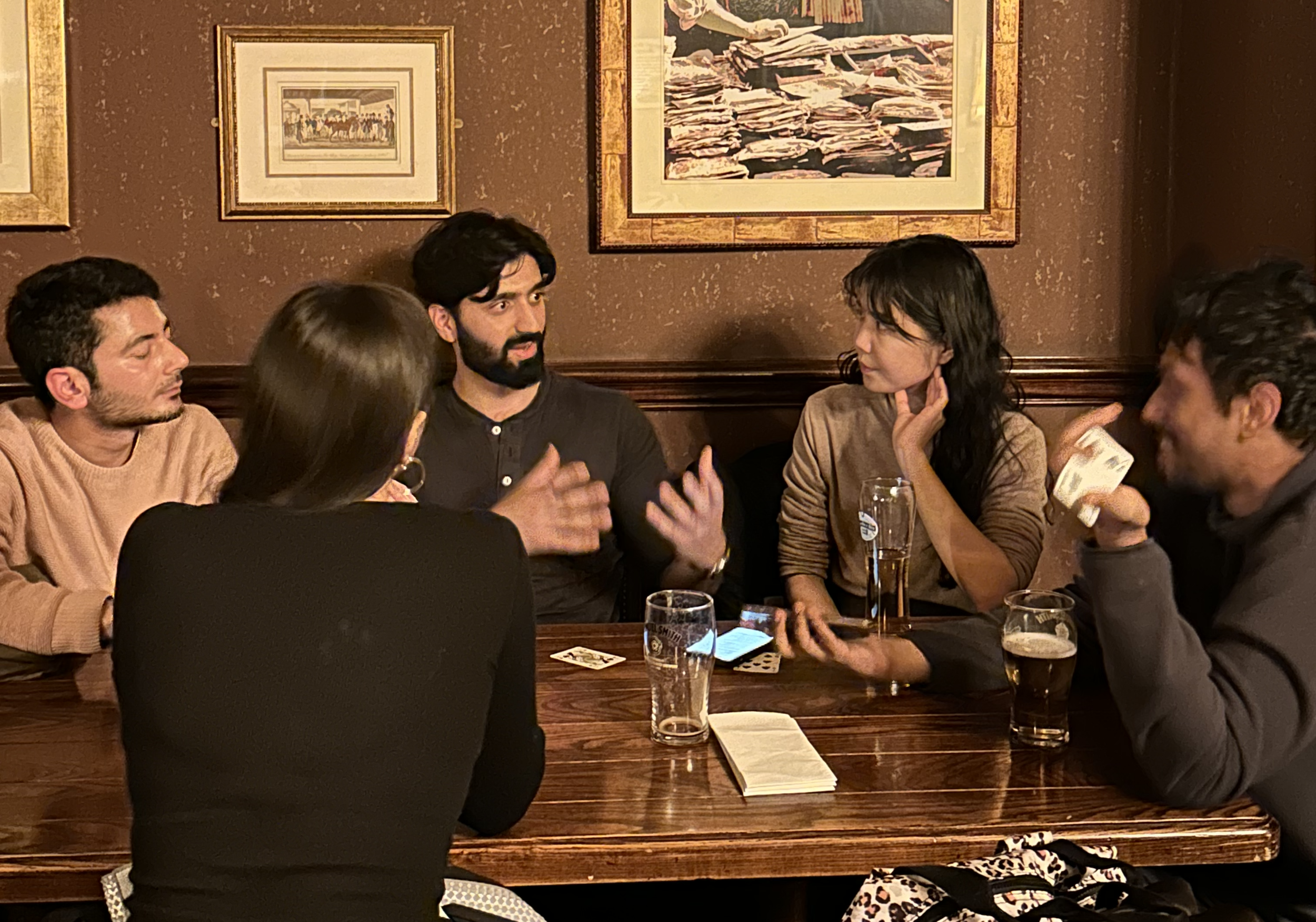
Every third Tuesday, about fifteen people gather in the back room of a pub. They call it The Thinking Gym. Just like gyms for exercising our physical bodies, this gym is about exercising minds.
The format is simple. Nobody knows the topic in advance. It is revealed in the room, from a sealed envelope. Tonight the topic is COGNITIVE HEALTH, and the envelope contains a single question:
"Is there anything you used to be able to think about that you can't anymore?"
DIANA, a secondary school teacher, says she used to be able to read a difficult book and hold the whole argument in her head across several days. Now she reaches the end of a chapter and has already lost the beginning.
KWAME, a software engineer, says he reaches for autocomplete before he's finished forming the thought himself. "I'm not entirely sure," he says, "whether the thought I end up with is mine."
ROSA, who runs a small business, isn't convinced. "Maybe I'm just faster now. Maybe that's fine. Maybe this is what it always felt like to adapt."
Later, someone raises an uncomfortable question. The people in this room are, by and large, already people who think carefully — who read, reflect, seek out conversations like this one. The people who might benefit most from a Thinking Gym probably aren't there. And getting there required a free Tuesday evening, no caring responsibilities, the kind of job that doesn't leave you too depleted to be curious by 7pm.
"I don't want to be defeatist," Diana says. "But I do wonder whether gathering in a pub in Zone 2 can meaningfully address something that is happening in every school, every workplace, and every house in the country."
Nobody has a clean answer, but the group orders another round and keeps chatting.
Some thoughts linger long after the pub has shut its doors.
QUESTIONS TO CONSIDER:
Do you recognise Diana or Kwame's experience in yourself? What about Rosa's scepticism?
Is what they're describing a loss? Or is it an adaptation? How would you tell the difference, and does it matter?
Is "cognitive health" a useful concept?
The access problem is real: who can actually get to something like this, on a Tuesday evening, in the right state of mind? Does that make it irrelevant, or just limited?
Is individual practice — reading carefully, having unstructured conversations, forming opinions before reaching for a chatbot — meaningful resistance to structural forces? Is it enough?
You are sitting in a potential version of The Thinking Gym right now. Is it working? What would convince you that it does?
How could Thinking Gyms be made accessible to more people?
P.S. Francesca (author of tonight’s thought experiments) is currently researching and developing the concept/format of the “Thinking Gym” - if you are interested go talk to her after the event or reach out here!
SOURCES & FURTHER READING:
Derek Thompson, The End of Thinking (Substack, 2025)
Rebecca Solnit, What Technology Takes From Us — And How to Take It Back (The Guardian, 2026)
Kosmyna et al., Your Brain on ChatGPT: Accumulation of Cognitive Debt when Using an AI Assistant for Essay Writing Task (arXiv, 2025)
Michael Gerlich, AI Tools in Society: Impacts on Cognitive Offloading and the Future of Critical Thinking (MDPI, 2025)
Thought Experiment is written by FG, TEiP Group Member, assisted by AI. You can read more of her writing here.
Please follow us on Instagram :-) @thoughtexperimentsinpubs

Our newsletter (and more):
FEEDBACK
(Messages are anonymous unless you include your name/contact details)