THOUGHT EXPERIMENTS IN PUBS
ON PATIOS
AUSTIN, TX
THE PILOT

1 NEW SOCIETY
Suppose that you and a group of people have to decide on the principles that will establish a brand new society.
However, none of you know anything about who you will be in that society.
You don’t know what your income level, sex, gender, race, religion, personal preferences (etc.) will be.
After you decide on the principles for your new society, you will be turned out into the society that you’ve designed.
QUESTIONS TO CONSIDER:
How will that society turn out?
Does knowing that you’ll be randomly turned out into the new society effect your design of society?
If you knew you’d be you (who you are today), would your society design change or be the same?
On what principles are you making decisions?
SOURCE:
BA, TEiP Group Member inspired by: Hendricks, Scotty. “7 Thought Experiments That Will Make You Question Everything.” Big Think, 15 Feb. 2023, bigthink.com/personal-growth/seven-thought-experiments-thatll-make-you-question-everything/.
2 CULTIVATING CURIOSITY
Two friends are talking.
One says she has been feeling low and has lost interest in everything. Her friend suggests that curiosity might help bring her back to life a little.
She disagrees.
“Curiosity isn’t something you can force,” she says. “You need to feel better first, and then curiosity returns.”
Her friend replies:
“Maybe curiosity does not appear out of nowhere. Maybe certain conditions help it grow: art, new ideas, stories, beauty, surprise, good questions.”
The first friend says:
“But what if my mind isn’t in the right condition for any of that to work?”
QUESTIONS TO CONSIDER:
Can curiosity be cultivated intentionally, or does it only arise when a person already feels well?
Can curiosity improve mood, or is it mostly a result of improved mood?
What kinds of experiences awaken curiosity in you?
What in modern life helps curiosity flourish, and what suppresses it?
Is curiosity necessary for a good life?
SOURCE: Written by BA, THOUGHT EXPERIMENTS IN PUBS Group Member, abridged by NF
3 MEANINGFUL LIFE
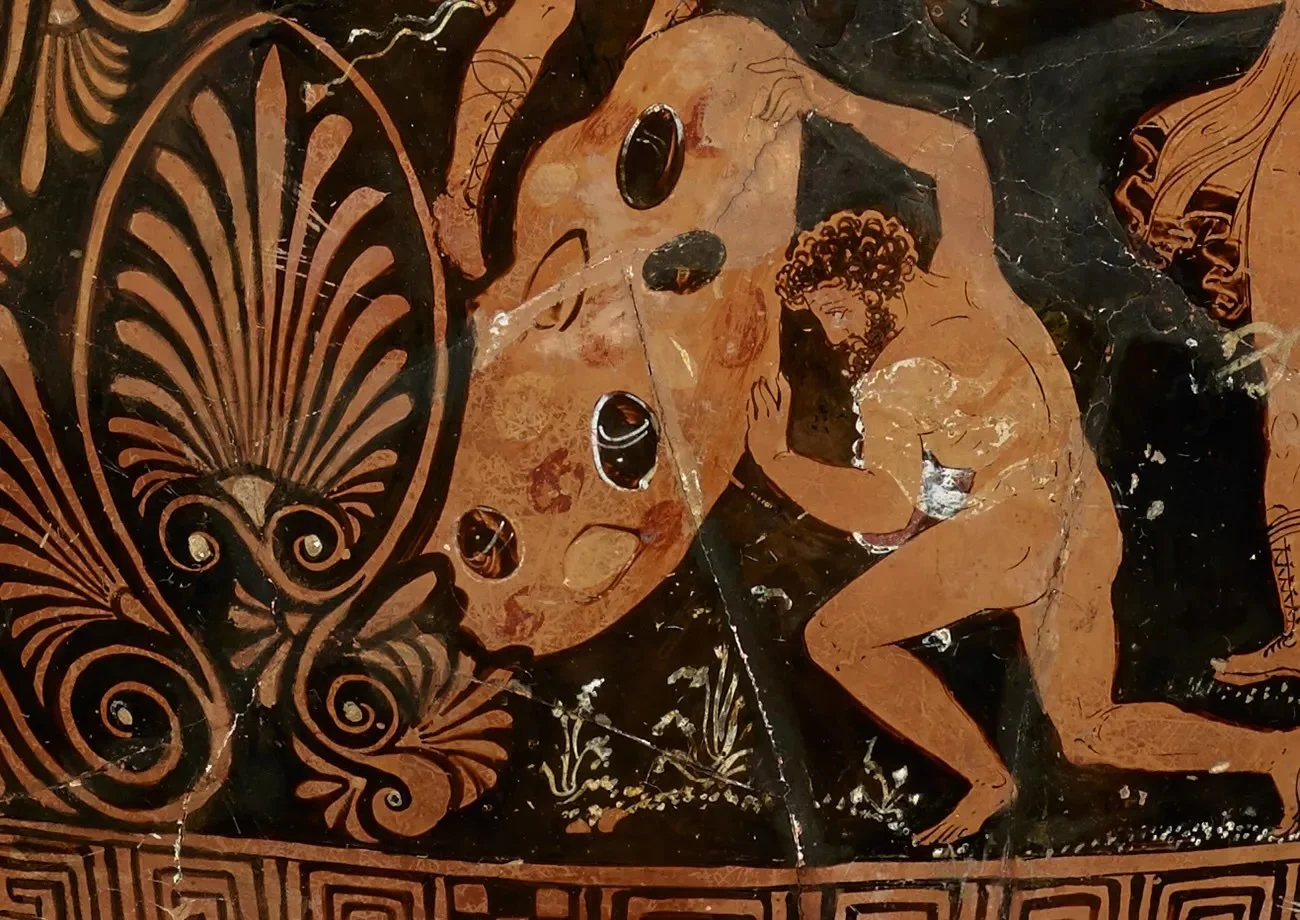
You’re in a museum, in Naples, reading a plaque about a vase.
Sisyphus was the king of Ephyra.
He cheated death twice, infuriating Hades, god of the underworld.
Hades’ revenge was cruel:
He forced Sisyphus to roll an immense boulder up a hill, only for it to roll back down every time it neared the top.
Hades condemned Sisyphus to repeat this action for all eternity.
Hades considered this meaningless existence to be the ultimate punishment; a punishment far worse than death.
Your friend, standing next to you, reading over your shoulder says:
“Suppose you injected Sisyphus with a drug that made his experience feel deeply meaningful to him, would it be meaningful?”
QUESTIONS TO CONSIDER:
Do you agree with Hades that a ‘meaningless existence’ is a worse punishment than death?
What do you think of your friend’s question?
If Sisyphus found his task meaningful, would it be meaningful?
What makes something ‘meaningful’?
How important is ‘meaning’?
SOURCE: BA, THOUGHT EXPERIMENTS IN PUBS Group Member, inspired by BM and derived from Susan Wolf’s Meaning in Life & Why it Matters
Image: Underworld Krater from Altamura, South Italian, made in Apulia, 360–340 BC; terracotta. Attributed to the Circle of the Lycurgus Painter. National Archaeological Museum of Naples
4 CONSIDERED GRAFFITI
Once a month, before a regular appointment, you stop at the same café. The café has one bathroom cubicle, and its walls are covered in graffiti: jokes, flirtation, slogans, corrections, arguments.
But among the usual scribbles are longer, more thoughtful messages.
One month, you notice this written on the wall:
Some thoughts on friendship
Friendship depends on showing up. Without some consistency, closeness is hard to build.
Friendship requires honesty and vulnerability. Without openness, there is no real connection.
Friendship should go beyond surface-level updates. It should involve a genuine meeting of minds.
You take a photo and think about the person who wrote it.
The next month, there is a reply underneath:
Showing up matters, but friendship also includes the freedom to fall short. A person can be flaky and still be a real friend.
Friendship is not always about confession. Sometimes it means knowing your friend is carrying something heavy and not demanding access to it.
Friendship is not only depth. It is also the mundane, the embarrassing, the ordinary. Sending a photo of a rash and trusting the other person not to recoil can be its own kind of intimacy.
Below both messages, someone has written a phone number and added:
I’ll be your friend.
QUESTIONS TO CONSIDER:
Which view of friendship do you find more convincing?
What do the two messages suggest about the people who wrote them?
Is ordinary familiarity a deeper form of intimacy than emotional openness, or just a different one?
How much flakiness can friendship survive?
Would you trust the phone number? Why or why not?
Would the exchange feel different if you came across it online rather than on a bathroom wall?
SOURCE: BA, THOUGHT EXPERIMENTS IN PUBS Group Members, abridged by NF
Our newsletter (and more):
TEiP on Instagram: @thoughtexperimentsinpubs
FEEDBACK
(Messages are anonymous unless you include your name/contact details)
If you’d like to support these me write more THOUGHT EXPERIMENTS and arrange more meetups, please
Thank you, your support means a lot :-)